


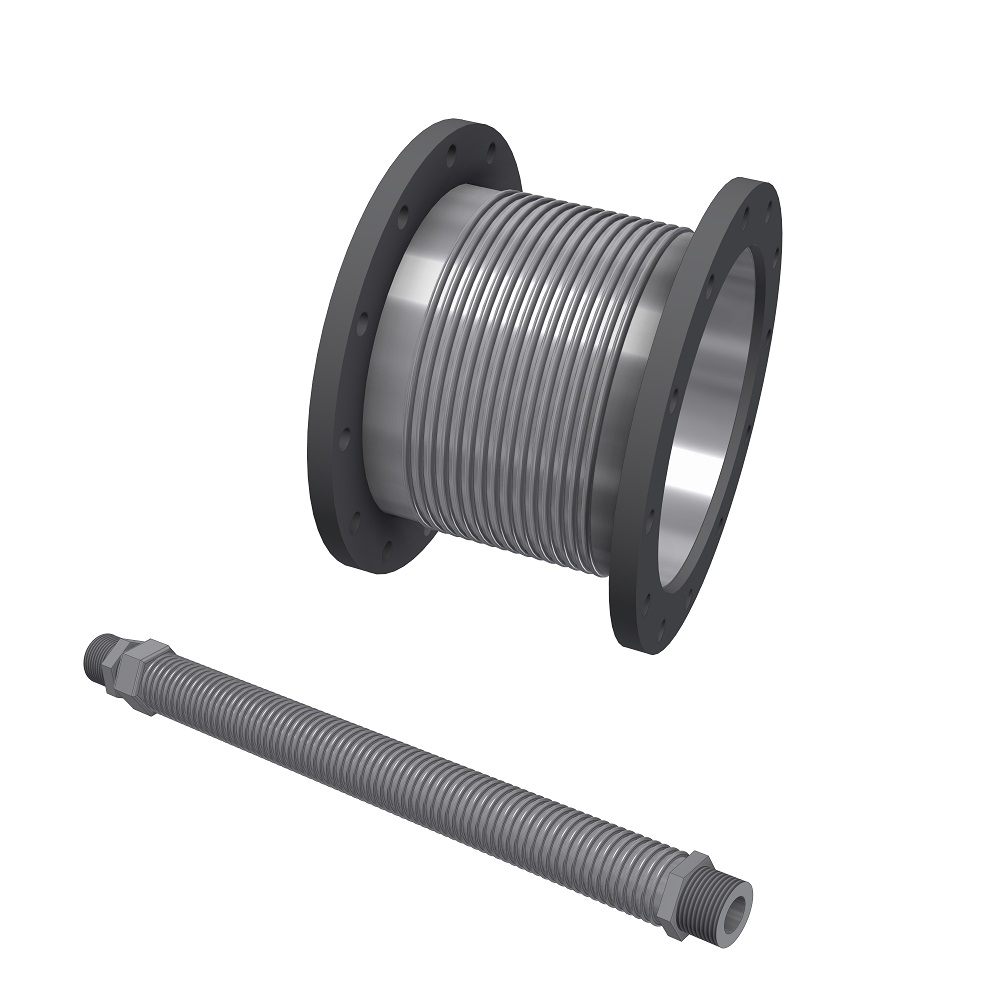
FN & ESA FLEX & INOXESTENS - Flexible joints and compensators
The flexible hoses are used on low pressure air or gas piping installation. They simplify the installation and connection of pipelines. This allows some alignment and position flexibility. The hoses have been designed also to prevent damage to burners, valves, regulators, blowers and accessories. This is achieved by reducing the stresses and strains of vibration, misalignment and thermal expansion of furnace and piping.
Description
The FN, ESA FLEX and INOXESTENS series of flexible joints and compensators are designed to meet the demands of industrial pipelines carrying air, gas, or oxygen, providing effective solutions for absorbing thermal expansion and correcting misalignments. These components play a crucial role in protecting burners, valves and control devices by reducing mechanical stress and preventing damage caused by vibration, torsion or dimensional variations along fluid transport lines.
The FN flexible hoses consist of corrugated AISI 321 stainless steel tubes with brazed ends. Up to model 24FN they feature threaded terminations, whereas larger sizes are supplied with weld‑ready ends. They withstand temperatures up to 500°C, with maximum operating pressure depending on the specific size. The ESA FLEX series includes flanged flexible metal hoses with an AISI 304 protective braid. These models are suitable for air temperatures up to 500°C and for gas up to 250°C, and can comply with PED requirements on request. Their maximum allowable pressure reaches 16 bar for smaller diameters.
The INOXESTENS series consists of fully stainless‑steel extensible joints made from AISI 316, designed for temperatures between –40°C and +100°C. They are available with either fixed or rotating fittings and allow controlled elongation, making them especially useful in pipeline layouts requiring adaptability. Their allowable working pressure and curvature radius vary according to the nominal diameter.
Installation procedures require careful alignment, internal cleaning, proper use of sealing pastes, and attention to tightening sequences to prevent excessive stress on the system. Separate guidelines exist for threaded, flanged and welded versions, but all require a final leak‑tightness test. It is essential to avoid twisting or over‑bending the hoses, as this may cause premature failure.
A dedicated maintenance plan ensures continued safety and performance, including checks on gasket integrity, bolt tightening and inspection of the compensators for wear, deformation or abrasion.
Additional information
| Series | |
|---|---|
| Sectors | Aluminum, Food, Glass&Ceramic, Heat treatments, Other metals, Process, RTO&Incineration, Steel |


