


HEAT RECOVERY TECHNOLOGIES
Unlock efficiency with "REGE" and "SELFREGE"
Regenerative burners use the heat of the flue gases to preheat the combustion air. To this end, a pair of burners is used, each equipped with a “regenerative bed”, that is a tank full of alumina balls, while the heat exchange takes place in a two-phase cycle. When the first burner turns on, the second works as a chimney, i.e. it heats the ceramic spheres with the flue gases in the furnace.
After, the first burner turns off, the second one turns on and uses the combustion air which is pre-heated passing through the hot regenerative bed, and so on.
By heating the combustion air to the highest temperatures, maximum levels of efficiency are achieved.
If instead of a pair, a single burner is used with two integrated regenerative beds, this is a “self-regenerative” burner.

Long flame regenerative burners
Equipped with a refractory combustion head and regenerative beds filled with alumina balls, free-flame regenerative burners REGE–FF–Nxt deliver an extended flame for highly efficient heat transfer. They operate with a wide range of fuels: gaseous (NG, LPG, H₂ and blends, COG/BFG) or liquid (diesel and biofuels), and are available up to 5 MW ( higher on demand).
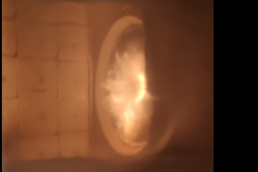
Flat flame regenerative burners
Flat (sidewall) flame burners REGE-SW-Nxt maximize heat transfer by exploiting the reverberatory effects of the furnace walls reaching so very high temperatures. Possible use of multiple gaseous fuels (NG, LPG, H2 & Blends).

Customized regenerative burners
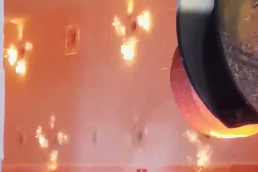
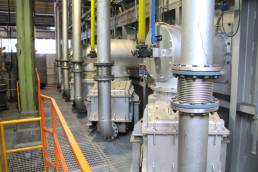
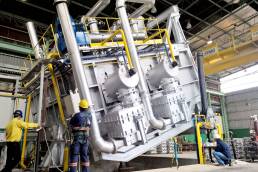
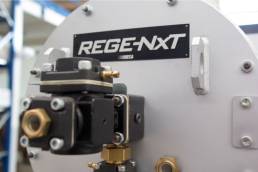
The REGE–NxT burner allows flexible assembly of the regenerator at 30° increments, from the leftmost to the rightmost position. The regenerator can also be designed “upside down” as in the picture, and provided with different air inlets, according to the furnace design.

Choosing Regenerative Burners
Many solutions for every application
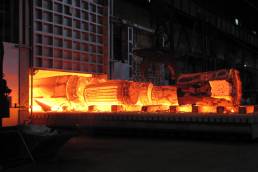
Regenerative technology is ideal for processes with high heat demand.
We offer configurations with long or flat flames and external regenerators, or high-speed flames with integrated regenerators, whatever the fuels.
Metallurgy and heat treatment are the primary application sectors, where performance improves with higher preheated air temperatures, making this solution highly effective.
FAQ ABOUT REGENERATIVE BURNERS
The efficiency of a furnace depends on multiple factors and the type of application. However, in ESA experience we can state that compared to cold air burners, regenerative burners allow fuel savings of over 50%. Various strategies are currently being studied to achieve even greater levels of efficiency.
The NOx problem is directly related to the increase in efficiency. The use of diluted combustion techniques (flameless and staged) makes it possible to reach very low “relative” emissions thresholds. If it is true that relative NOx can be high, it is equally true that thanks to the huge fuel savings, in reality the quantity of absolute NOx emitted are reduced, a fundamental aspect often ignored by regulations, not to mention the reduction of CO2 and other resources.
Yes, although the higher flame temperature and its tendency to stitch to the nozzle cause significant increases in NOx emissions. Nonetheless, the considerations already set out above apply here, with the added advantage of further reductions/cancellations of CO2 emissions.
Unfortunately, generalizations cannot be made. Too many input/outputs (i.e the fuel directly used, the quality and the quantity of the metal obtained, times, oxygen availability…) should be considered, so that in practice, oxy fuel technology is chosen mostly depending on the presence of very contaminated wastes, which the oxygen can much more easily burn.
Despite a slightly superior heat exchange power, ceramic honeycombs are too fragile, too expensive and subject to quickly clog for an industrial use. Alumina balls on the opposite can be used several times by simply washing them, are cheap, and if they break down, they get even higher heat exchange efficiency!
Contact us to receive support or to request information